-
tel:
+8613770272989
-
email:
admin@trimbleglobe.com

About Alumina Ceramics
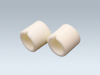
About Alumina Ceramics
Alumina ceramics are a common and relatively traditional material for advanced precision ceramics. High purity alumina ceramics have been widely used in many industries as an excellent ceramic material. The material has good properties in terms of electrical insulation, high thermal conductivity, high chemical resistance, good wear resistance and low thermal expansion.
Alumina ceramics can be divided into several application grades according to their alumina content, where 99% alumina porcelain materials are used to make high temperature crucibles, refractory furnace tubes and special wear-resistant materials such as ceramic bearings, ceramic seals and water valve pieces; 95%-96% alumina porcelain is mainly used as corrosion-resistant, wear-resistant components and circuit substrates.
Chemical formula of alumina.
Aluminum oxide has a molecular weight of 102, Al2O3 is the main source of aluminum in nature. al2O3 has a very high melting point, i.e. 2,072°C, and is very hard.
Colors of alumina.
Alumina ceramics vary in color depending on their alumina content. 95%-96% alumina porcelain is milky white, while 99% alumina porcelain is yellow.
Density of alumina.
Alumina ceramics vary in density according to their alumina content. 95%-96% alumina porcelain is 3.7-3.8g/cm³, while 99% alumina porcelain is 3.8-3.9g/cm³.
Properties of alumina.
Excellent electrical insulation (1×10 14 ~ 1×10 15Ω cm);
Medium to ultra-high mechanical strength (300 to 630 MPa)
Very high compressive strength (2000 to 4000 MPa).
High hardness (15 to 19 GPA).
Medium thermal conductivity (20 to 30 W/MK);
high corrosion and wear resistance.
Good abrasive properties.
Low density (3.75 to 3.95 g/cm3).
Operating temperatures of 1000 to 1500°C without mechanical load.
Bioinertia, food compatibility.
Related News

.png?x-oss-process=image/resize,w_100/quality,q_100)
Contact US
Product Information
Quantity
Unit
Piece
Support order samples, customization, wholesale direct, and complete payment. If the product you look for does not have corresponding customized content, pls fill out the form below to contact us, and we will reply ASAP.