-
tel:
+8613770272989
-
email:
admin@trimbleglobe.com

Features and advantages of far infrared heaters

There are three main ways of heat transfer: heat conduction, heat convection and heat radiation. The so-called far-infrared heating technology is the process of using far-infrared radiation heat energy to heat objects. The way of energy transfer is thermal radiation, which has the following characteristics:
1
The radiation energy propagates at the speed of light between the radiation source and the heated body, the energy transfer speed is extremely fast, and there is no need to pass through other media such as air, and the heat loss is very small.
2
The energy of far-infrared radiation can be directly absorbed by the molecules of the substance and cause a resonance effect without being blocked by the surface layer of the substance, so it has a high heating rate.
3
A large number of organic matter and water-containing substances have strong absorption bands for far-infrared rays, so far-infrared rays have good heat transfer and penetration properties in these substances. As long as all or most of the radiation energy emitted by the radiation source is concentrated in the absorption peak band of the material, most of the radiation energy will be absorbed to achieve good matching and energy saving.
4
Far-infrared rays are a kind of invisible light, which propagates in a straight line. The performance of directional emission is good. According to the requirements of use, the emitted far-infrared rays can be directed, gathered and other technical processing.
5
In the process of far-infrared radiation heating, the surface and below the surface of the heated object absorb far-infrared rays at the same time, so the heating is uniform and the heating quality is guaranteed.
6
Far-infrared radiation has no thermal inertia, can start working in a short time, and can also stop working in a short time, which is easy to realize intelligent control.
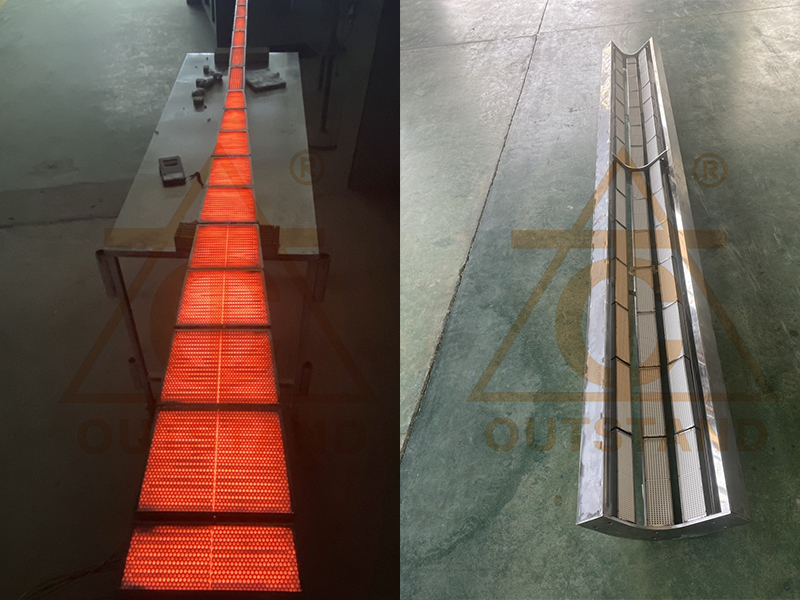
Because of these characteristics, compared with traditional heating methods such as steam, hot air and resistance, far-infrared heating has the advantages of fast heating speed, good heating quality, small equipment footprint, low production cost and high heating efficiency.
Related News

.png?x-oss-process=image/resize,w_100/quality,q_100)


Contact US
Product Information
Quantity
Unit
Piece
Support order samples, customization, wholesale direct, and complete payment. If the product you look for does not have corresponding customized content, pls fill out the form below to contact us, and we will reply ASAP.